Angry Clowns of the Climate Circus
 Adult climate catastrophists have flipped to censorship, abuse and hysteria to back tomorrow’s climate-truant kids and the latest UN gabfest in New York on Monday. The ‘progressive’ media has dropped its mask of objectivity, with more than 170 global outlets (possibly 250-plus) pledged to print a week of one-sided climate-doom stories ahead of the UN summit.
The fruits are now on display in Australia at the academic’s playground The Conversation, funded by scores of universities and, indirectly, taxpayers. Editor and executive director Misha Ketchell posted on Tuesday a note banning all sceptic views: “Climate change deniers are dangerous – they don’t deserve a place on our site.”
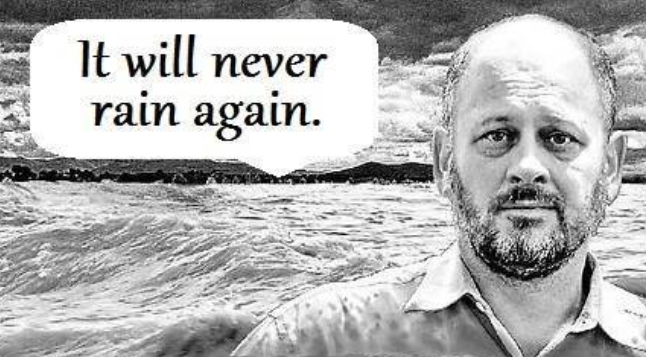
Instead, The Conversation the very same day put up a piece by Tim Flannery calling sceptics child “predators”. This on a website that continues to boast “We believe in the free flow of information.”
Ketchell has the perfect pedigree to be peddling the catastropharian party line. He has been an Agereporter, Crikey editor and for several years was an ABC producer on Media Watch and 7.30, and an editor of The Drum. His Conversation editorial note says,
Once upon a time, we might have viewed climate sceptics as merely frustrating. We relied on other commenters and authors to rebut sceptics and deniers, which often lead to endless back and forth.
But it’s 2019, and now we know better. Climate change deniers, and those shamelessly peddling pseudoscience and misinformation, are perpetuating ideas that will ultimately destroy the planet. As a publisher, giving them a voice on our site contributes to a stalled public discourse.
That’s why the editorial team in Australia is implementing a zero-tolerance approach to moderating climate change deniers, and sceptics. Not only will we be removing their comments, we’ll be locking their accounts.
We believe conversations are integral to sharing knowledge, but…it is counter productive to present the evidence and then immediately undermine it by giving space to trolls. The hopeless debates between those with evidence and those who fabricate simply stalls action.
We know you want to have constructive positive discussions, so please don’t engage with the climate change deniers. Dob them in and help us create a space where they don’t derail the conversation.
World-respected sceptic educator Joanne Nova, of Perth, comments, “Every hypocrite, pocket-dictator and cult-ruler uses some version of ‘it’s better for you if I protect you from hearing things I deem unworthy’. Conversation obviously isn’t going to happen at The Conversation.” Inviting anyone disagreeing with her to comment on her site, she asks of Ketchell’s ban: “So who’s a troll then? Roy Spencer? Ph.D. in meteorology, NASA’s Exceptional Scientific Achievement Medal, supported by NASA, NOAA, and DOE [US Dept of Energy]?”
She also cites as sceptics “Nobel prize winners of physics and men who walked on the moon. Freeman Dyson. Shame none of them are as smart as Ketchell.”
Half the population of Australia, the UK, USA, NZ and Canada are to Ketchell “trolls”, she writes.
A ten-second online search shows 56 per cent of Canadians are skeptics. Likewise, 54 per cent of Australians are skeptics (a CSIRO estimate). The latest YouGov survey shows 63 per cent of the USA, 56 per cent of Australians, and 49 per cent of the Brits don’t think the IPCC is right. If a majority ‘agreed with the consensus’ why is it that most Australians don’t want to pay even a tiny $10 a month for renewables to save the world? On flights, not even two bucks a trip. Nearly half of US adults don’t want to pay $1 a month. And the British don’t want to pay a cent.
Survey after survey shows that when people rank issues, climate concerns are flat at the bottom of the barrel. Only three per cent of US people think climate is most important issue.[i]
Tim Flannery, freed from rebuttal or mockery by the site’s commenters, published on The Conversation the same day an unhinged rant branding sceptics and major CO2 emitters as not just “idiots” but predators equivalent to child-harmers. The piece was headed, “The gloves are off: ‘predatory’ climate deniers are a threat to our children.” It’s not quite a bare-knuckle boxing match when no opponent is allowed into the ring.
Flannery is chief councilor of the Climate Council, which purports to “provide authoritative, expert advice to the Australian public on climate change and solutions based on the most up-to-date science available.” Also a Fellow of the Australian Academy of Science, he writes
How should Australia’s parents deal with those who labour so joyously to create a world in which a large portion of humanity will perish? As I have become ever more furious at the polluters and denialists, I have come to understand they are threatening my children’s well-being as much as anyone who might seek to harm a child.
He suggests a purported 4degC global warming by 2100 could kill many billions of people, leaving a mere 1 billion survivors
Mass deaths are predicted to result from, among other causes, disease outbreaks, air pollution, malnutrition and starvation, heatwaves, and suicide.
My children, and those of many prominent polluters and climate denialists, will probably live to be part of that grim winnowing – a world that the Alan Joneses and Andrew Bolts of the world have laboured so hard to create.
The absurdity of this line of extremism was pointed out a fortnight ago by secretary-general of the World Meteorological Organisation Petteri Taalas. The WMO combined with the UN to set up the Intergovernmental Panel on Climate Change in 1988. Taalas said agitators whom he called “doomsters” have been behaving like “religious extremists”, demanding unrealistic emission cuts and sacrifices and making threats against the real climate scientists. “It’s not going to be the end of the world,” he told a Finnish financial journal. “The atmosphere created by media has been provoking anxiety.”
Flannery in his piece writes of his disgust at the results of May’s “climate election”, which he asserts “shattered meaningful democracy” and compounded his “colossal failure” from 20 years of activism to get CO2 emissions down. He suggests that his supporters need to abandon discussion and debate and rise up in Extinction Rebellion-type “actions”, noting that “words have not cut through” and asking if “rebellion is the only option?”
ABC Science, in its email to subscribers of September 18, gave Flannery an endorsement for his “hard-hitting” message, saying:
Are ‘predatory’ climate deniers a threat to our kids? The answer is ‘yes’, according to Tim Flannery in this hard-hitting opinion piece that also reflects on what our future might look like. We know the science, and the predictions. So – as thousands of people prepare to strike for the climate this Friday – what will it take to see changes made?
Flannery’s article notes that he is also a professorial fellow at Melbourne University’s Sustainable Society Institute.[ii] Melbourne University among others both funds The Conversation and paradoxically is putting out pro forma statements endorsing the need for campus free speech, as urged by former High Court chief justice Robert French.[iii]
Flannery writes,
Young people themselves are now mobilising against the danger. Increasingly they’re giving up on words, and resorting to actions. Extinction Rebellion is the Anthropocene’s answer to the UK working class Chartists, the US Declaration of Independence, and the defenders of the Eureka Stockade.
Its declaration states:
“This is our darkest hour. Humanity finds itself embroiled in an event unprecedented in its history, one which, unless immediately addressed, will catapult us further into the destruction of all we hold dear […] The wilful complicity displayed by our government has shattered meaningful democracy and cast aside the common interest in favour of short-term gain and private profit […] We hereby declare the bonds of the social contract to be null and void.”
Not yet a year old, Extinction Rebellion has had an enormous impact. In April it shut down six critical locations in London, overwhelmed the police and justice system with 1,000 arrests, and forced the British government to become the first nation ever to declare a climate emergency.
He tells school heads to permit kids to play the wag, “in an effort to save themselves [kids] from the climate predators in our midst, or force them to stay and study for a future that will not, on current trends, eventuate. I will be marching with the strikers in Melbourne, and I believe teachers should join their pupils on that day.”
Petteri Taalas of the World Meteorological Organisation copped such a thrashing for calling out extremist nonsense on climate that he had to put out another statement a week later pointing out that he was a true believer in IPCC predictions. But he did not resile from any of his previous comments, merely blustering that they had been “selectively interpreted”. He said, “We must not be driven to despair, given that reasonable, consensus-based solutions are available.”
Here’s from the original Taalas interview:
While climate scepticism has become less of an issue, now we are being challenged from the other side. They are doomsters and extremists; they make threats. Much more radical action is demanded by Extinction Rebellion movement. They demand zero emissions by 2025 and ‘honest’ climate information from governments…
The IPCC reports have been read in a similar way to the Bible: you try to find certain pieces or sections from which you try to justify your extreme views. This resembles religious extremism. We should consider critically, and with reservations, the thoughts of experts…
The latest idea is that children are a negative thing. I am worried for young mothers, who are already under much pressure. This will only add to their burden.
Benny Peiser is director of sceptic-leaning London-based Global Warming Policy Foundation, which picked up and disseminated the Taalas interview. Peiser said, “It’s very disappointing that another official has been forced to back down after making a perfectly reasonable statement. It undermines trust in the whole field.”
The New Yorker didn’t cover the Taalas story, understandably, but it did run with novelist Jonathan Franzen asking, What If We Stopped Pretending? The climate apocalypse is coming. A snippet:
Finally, overwhelming numbers of human beings … have to be permanently terrified by hotter summers and more frequent natural disasters, rather than just getting used to them.
Every day, instead of thinking about breakfast, they have to think about death.
Peiser attributed Taalas’ initial warning to fears about green warriors “hell-bent on undermining the economies and social stability of Europe.” Germany’s largest industry, automobile manufacturing, is a case in point. Volkswagen’s CEO Herbert Diess last week bewailed that greens have pushed the industry and its 830,000 jobs to the “brink of collapse”. The latest campaign is to force Germans into electric cars which, at root, are coal-powered anyway. “That drives the idea of electric mobility ad absurdum!” Diess said.
Panics about warming have a long reach. The BBC once panicked Scots with a report that warming threatens haggis, because sheep lungs – the tasty base – will get more parasites. Warming will give Kansas people painful kidney stones, because they’ll sweat more and pee less. Easter Island statues are to toppleas climate seas erode their platforms. Grizzlies and polar bears will start dating and produce “Grolars”, or maybe pizzly bears. (Sign for school truants: Save the Grolar Bears!)
More seriously, there’s the widely believed story that “half the Barrier Reef is dead”. Award-winning climate scientist Dr Joelle Gergis (ANU) says so in her Sunburnt Country book, “Half of the coral of the Great Barrier Reef is now dead. It’s a global-scale ecological catastrophe.” I dropped a line to the GBR Marine Park Authority last month to ask if the “half-dead” story is true. The chief scientist, Dr David Wachenfeld, replied, avoiding the question, that 30 per cent of the shallow water (2-10m) corals were lost in 2016 and in 2017 there were further declines across the northern two-thirds: “Despite the loss of coral and damage to reefs in many parts of the Marine Park, the entire Reef remains a resilient ecosystem, with early signs of recovery processes in many damaged areas … Many areas continue to support beautiful corals and abundant marine life and the Reef remains an extraordinary experience for visitors.” I hope Dr Wachenfeld can get that message across to Gergis and Flannery and their sciency Climate Council.
Taalas is not the only climate dignitary who has challenged the extremists. Dr Andy Pitman, director of the UNSW’s Centre of Excellence for Climate Extremes, cautioned at a Sydney climate forum last June, “As far as the climate scientists know there is no link between climate change and drought. That may not be what you read in the newspapers.” I assume Pitman will henceforth be banned from The Conversation.
In more detail about Monday’s UN summit, Secretary-General António Guterres called the meeting because he says global efforts to tackle climate change are running off-track, according to Dr Frank Jotzo, Director of ANU’s Centre for Climate and Energy Policy.[iv] The new pledges should be in line with a 45 per cent cut to global greenhouse gas emissions over the next decade, and net-zero emissions by 2050. Australia’s pledge is 26-28 per cent below 2005 levels by 2030. The Paris pledges are supposed to be reviewed and strengthened every five years. China and India, the world’s two largest emitters, have made no commitment to cuts before 2030.
Australia is not expected to propose any significant new actions or goals, Jotzo writes on The Conversation, in a piece illustrated with a low-lying Tuvalu island and the non-factual caption that it is “threatened by inundation from rising seas”. Jotzo says, “Prime Minister Scott Morrison – in the US at the time to visit President Donald Trump – will not attend the summit. Foreign Minister Marise Payne will attend, and is likely to have to fend off heavy criticism over Australia’s slow progress on climate action.”
In passing, Jotzo calls for the “phasing out some old energy-hungry and often uneconomic plants like aluminium smelters.” This would not suit 3650 hard-working Australians at the following smelters: Bell Bay and Boyne Island (Pacific Aluminium), Alcoa’s Portland refinery and the Tomago consortium in NSW. Aluminium and its elements also happen to be a $5b export industry. Jotzo’s insouciance about smelter jobs is just what you’d expect at a climate centre of excellence.
Tony Thomas’s new book, The West: An insider’s tale – A romping reporter in Perth’s innocent ’60s is available from Boffins Books, Perth, the Royal WA Historical Society (Nedlands) and online here
[i] For links go to her site
[ii] One MSSI staffer with a PhD would like emissions-conscious suburbanites to dispense with cars and return to horseback.
[iii] University of Melbourne vice-chancellor Duncan Maskell said the institution had started working on its policy before the French review. “Freedom of speech is a fundamental principle of our University – it always has been and always will be,” he said.
[iv] “This story is part of Covering Climate Now, a global collaboration of more than 250 news outlets to strengthen coverage of the climate story.”
 No B-S here (I hope)